
"seed longevity"
30 article(s) found

90 + Top Fine Coffee Lotus Solkiln H2 L95
Follow the caf é (Wechat official account vdailycom) and found that the beautiful cafe opened its own small shop, Lotus, also known as Lotus. Its double-flowered lotus is a sign of a prosperous life and a symbol of pure love. Among the flowers, it is the only one that can co-exist with flowers, fruits (lotus roots) and seeds (lotus seeds). Lotus mainly symbolizes beauty, love, longevity and holiness. It is also the Chinese god of June flowers.

Bama Le Live Coffee Shop on the Street of Ginza
On the streets of Ginza, Japan's busiest commercial street, a Lehuo coffee shop, which uses ingredients such as hemp kernel and sesame oil in Bama Yao Autonomous County, Guangxi, China, pushed the door and was greeted with a smile by waiters dressed in traditional Yao costumes.

How much is Yunnan Huaguoshan Coffee Price
For professional baristas, please follow the 34-year-old fruiting tree of Yunnan small grain coffee in the growing period of the coffee workshop (Wechat official account cafe_style). Coffee is a short-day plant. Coffee has the characteristics of multiple flowering and concentrated florescence. The florescence of small seed coffee in Yunnan is 27 months, and the flowering period is 35 months. The flowering of coffee is greatly affected by climate, especially rainfall and temperature. Coffee flower longevity

A comprehensive introduction to all aspects of coffee
The variety Coffea Robusta can grow to more than 12 meters above sea level to 600 meters above sea level and grows rapidly and has stronger resistance to insect pests. It was discovered in Congo in 1898, and the strong variety was widely spread, especially in places such as Africa, Asia and Indonesia where Coffea Arabica was not suitable for growing in climate. It accounts for 1/4 of the world's total output. Due to

21 amazing Coffee fact Coffee beans are Seeds drinking Coffee makes people live longer
When you hold a cup of sweet boutique coffee with citrus flavor in your hand, have you ever thought about some things about coffee? there are all those charming background stories behind the coffee. The front street coffee will take you in to take a look at the other side of the coffee and fill your coffee with thick stories. This drink can be traced back to the 800 AD legend of the 9th century.

Coffee common sense can coffee beans with two different flavors be blended?
Today, there are two main types of coffee grown in some of the most important producing countries: Arabica and Robusta. Several different species are obtained from the grafting of these two species, represented by the name of the producing country. Coffea Arabica, a valuable species, has been cultivated for centuries, accounting for 3/4 of the world's coffee production. As the name means, it
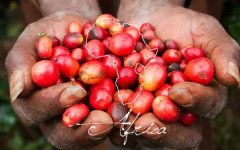
What's the difference between cocoa beans and coffee beans? The growth environment of cocoa beans plays a role in the characteristics and effects.
Professional coffee knowledge exchange more coffee bean information please follow coffee workshop (Wechat official account cafe_style) Coffee tree is Rubiaceae perennial evergreen shrub or small tree, is a horticultural perennial cash crop. The origin of the coffee tree is Ethiopia in Africa. As coffee belongs to tropical woody plants of Rubiaceae, climate is the decisive factor in coffee cultivation.
Cultivation of small Coffee in Yunnan
Small-grain coffee is suitable for living in mountains with an altitude of 800 to 1800 meters. If the altitude is too high, it will taste sour, and if it is too low, it will taste bitter. Small grains of coffee are mostly planted in dry and hot valleys at an altitude of 1100 meters above sea level, so they are moderately sour, rich and mellow.

Coffee bean varieties: the historical cause and classification of cocoa bean varieties are explained in detail.
Morphological characteristics of the trunk: up to 12 meters high, trees, wide branches, branchlets brown pubescent. The trunk is solid and the cacao trunk has a luxuriant crown. Leaves: alternate, elliptic, leathery, 20-30 cm long, slightly stellate hairy on veins. Flowers: old cauline flowers, blooming directly on the trunk or main branch, about 1.8 cm in diameter; Calyx pink, smelly. 5 deep cracks; petals 5, lower sunken helmets
Knowledge about Yunnan small grain coffee
Small-grain coffee is suitable for living in mountains with an altitude of 800 to 1800 meters. If the altitude is too high, it will taste sour, and if it is too low, it will taste bitter. Small grains of coffee are mostly planted in dry and hot valleys at an altitude of 1100 meters above sea level, so they are moderately sour, rich and mellow.

Washing and drying of coffee what else does it affect the oxidation reaction?
Professional coffee knowledge exchange more information about coffee beans Please follow the coffee workshop (Wechat official account cafe_style) washed / wet-treated coffee is famous for its excellent cleanliness. They make the coffee sparkle, whether it's shiny acidity or rich creamy taste. But only if they dry slowly, evenly and continuously. Mistakes in the drying stage may lead to fermentation

The Origin of Yunnan small-grain Coffee
The origin of Yunnan small-grain coffee: in 1892, the French preacher Father Tian succeeded in experimenting with growing coffee in a place called Zhu Kula in Yunnan. To the city of Guzhu Kula, there are still 24 coffee trees with more than 90 years old. Zhu Kula is a mysterious, colorful and natural village, attached to the Zhukula Village Committee, Pingdi Town, Binchuan County, Dali Prefecture, located in the trunk of the Jinsha River.

General knowledge of Fine Coffee cultivation of small Coffee in Yunnan
The origin of Yunnan small-grain coffee: in 1892, the French preacher Father Tian succeeded in experimenting with growing coffee in a place called Zhu Kula in Yunnan. To the city of Guzhu Kula, there are still 24 coffee trees with more than 90 years old. Zhu Kula is a mysterious, colorful and natural village, attached to the Zhukula Village Committee, Pingdi Town, Binchuan County, Dali Prefecture, located in the trunk of the Jinsha River.

What are Indonesian wet-bubble coffee beans? What are the flavor characteristics of coffee wet planing?
Professional coffee knowledge exchange more coffee bean information Please pay attention to the coffee workshop (Wechat official account cafe_style) Coffee is widely grown in different countries, different growing environments, and so on, will affect the taste of coffee. Asia has a large area of land and has many different kinds of beans in coffee-growing areas. The most famous ones include caffeine from Indonesia.

Basic knowledge of all aspects of coffee
Linnaeus (Swedish naturalist) classifies coffee plants into the Rubiaceae family, such as gardenia. The great naturalist named it Coffea.
Coffee Basics About Coffee Trees and Caffeine
Linnaeus classified coffee plants in the Rubiaceae family, e.g. Gardenia. The great naturalist named it Coffea. Although plants in the wild can grow to 10-12 metres tall, those in plantations are about 3 - 5 metres tall, except in Colombia, where few species exceed 2 metres. This makes farming and picking easier and cultivation more economical. leaves

Basic knowledge of all aspects of coffee
Linnaeus (Swedish naturalist) classifies coffee plants into the Rubiaceae family, such as gardenia. The great naturalist named it Coffea. Although wild plants can grow as high as 10-12 meters, the plantations are about 3 to 5 meters high, with the exception of Colombia, where tree species rarely exceed 2 meters. This makes farming and picking easier and more economical to cultivate. Leaves

Basic knowledge of all aspects of coffee decaf coffee
Linnaeus (Swedish naturalist) classifies coffee plants into the Rubiaceae family, such as gardenia. The great naturalist named it Coffea. Although wild plants can grow as high as 10-12 meters, the plantations are about 3 to 5 meters high, with the exception of Colombia, where tree species rarely exceed 2 meters. This makes farming and picking easier and more economical to cultivate. Leaves
The basic knowledge of coffee encyclopedia on all aspects of coffee
Linnaeus (Swedish naturalist) classifies coffee plants into the Rubiaceae family, such as gardenia. The great naturalist named it Coffea. Although wild plants can grow as high as 10-12 meters, the plantations are about 3 to 5 meters high, with the exception of Colombia, where tree species rarely exceed 2 meters. This makes farming and picking easier and more economical to cultivate. Leaves

Basic knowledge about all aspects of coffee-baristas must see
Linnaeus (Swedish naturalist) classifies coffee plants into the Rubiaceae family, such as gardenia. The great naturalist named it Coffea. Although wild plants can grow as high as 10-12 meters, the plantations are about 3 to 5 meters high, with the exception of Colombia, where tree species rarely exceed 2 meters. This makes farming and picking easier and more economical to cultivate. Leaves